
Introduction
Open a tap in most Malaysian states and there’s a good chance that somewhere between a quarter and nearly half of all the water treated to get there never reaches a paying customer. That’s the reality of Non-Revenue Water (NRW) — treated water lost to leaking pipes, unmetered connections, faulty meters, and theft — and it’s currently running at an estimated 25–40% across the country.
For plant managers, utility operators, and engineering leads across the water sector, the message is consistent: instrumentation and digital monitoring are no longer “nice to have” upgrades, they’re the backbone of how Malaysia plans to fix this.
Malaysia’s Non-Revenue Water Problem
NRW shows up in two forms: physical losses — water that leaks out of ageing pipe networks before it ever reaches a customer — and commercial losses — water that’s used but never billed, due to faulty meters, illegal connections, or data errors.
Reducing NRW isn’t just about saving water — it’s about reducing the energy and chemical cost of treating water that’s then lost, freeing up capacity without building new treatment plants, and making the network itself more resilient when something does go wrong upstream.
Malaysia’s Water Sector Transformation 2040 roadmap sets out an ambitious goal: growing the sector’s contribution to GDP to 0.45% by 2040, with an estimated RM172.6 billion in accumulated value-add between 2021 and 2040. NRW reduction sits at the centre of that plan, and the funding mechanism is direct — water operators that hit their NRW reduction KPIs can receive grants covering up to 75% of the capital expenditure on qualifying initiatives.
That’s already shaping major infrastructure projects on the ground: the Rasau water supply scheme, the Langat 2 water treatment plant, and the Perak–Penang water transfer scheme are all moving forward with larger-diameter piping and modern monitoring built in from the start. Add to that the rising water demand from Malaysia’s data centre boom, particularly in Johor and Selangor, and the pressure to operate the existing network more efficiently — not just build more of it — has never been higher.
ASIAWATER 2026 also marked the launch of an Incubator Hub by the National Water Services Commission (SPAN), specifically designed to accelerate adoption of new water technologies and bring innovators and utilities together. It’s a clear signal that the regulator wants smart, instrumented water infrastructure to move from pilot projects to standard practice.
Malaysia Water Digitalisation in Practice: Air Selangor’s Semenyih 2 Water Treatment Plant
The clearest proof point already exists in Malaysia. Air Selangor’s Semenyih 2 Water Treatment Plant, operating since 2022, became the country’s first fully automated water treatment plant — and has since been upgraded with Asset Digital Twin technology developed in partnership with Schneider Electric. The result is a facility that can run its standard operation, startup, and shutdown sequences autonomously, producing an average of 100 million litres per day, with productivity gains of up to 20%.
That’s not a one-off showcase project — the Semenyih 2 example demonstrates what is possible when water operators adopt greater automation, digital visibility and integrated control. It also reflects the direction in which Malaysia’s water infrastructure is moving: towards less manual intervention, better visibility into network performance, and earlier detection of issues such as leaks, pressure drops and water-quality abnormalities before they develop into supply disruptions.
The Instrumentation and Control Layer Behind Every NRW Reduction Programme
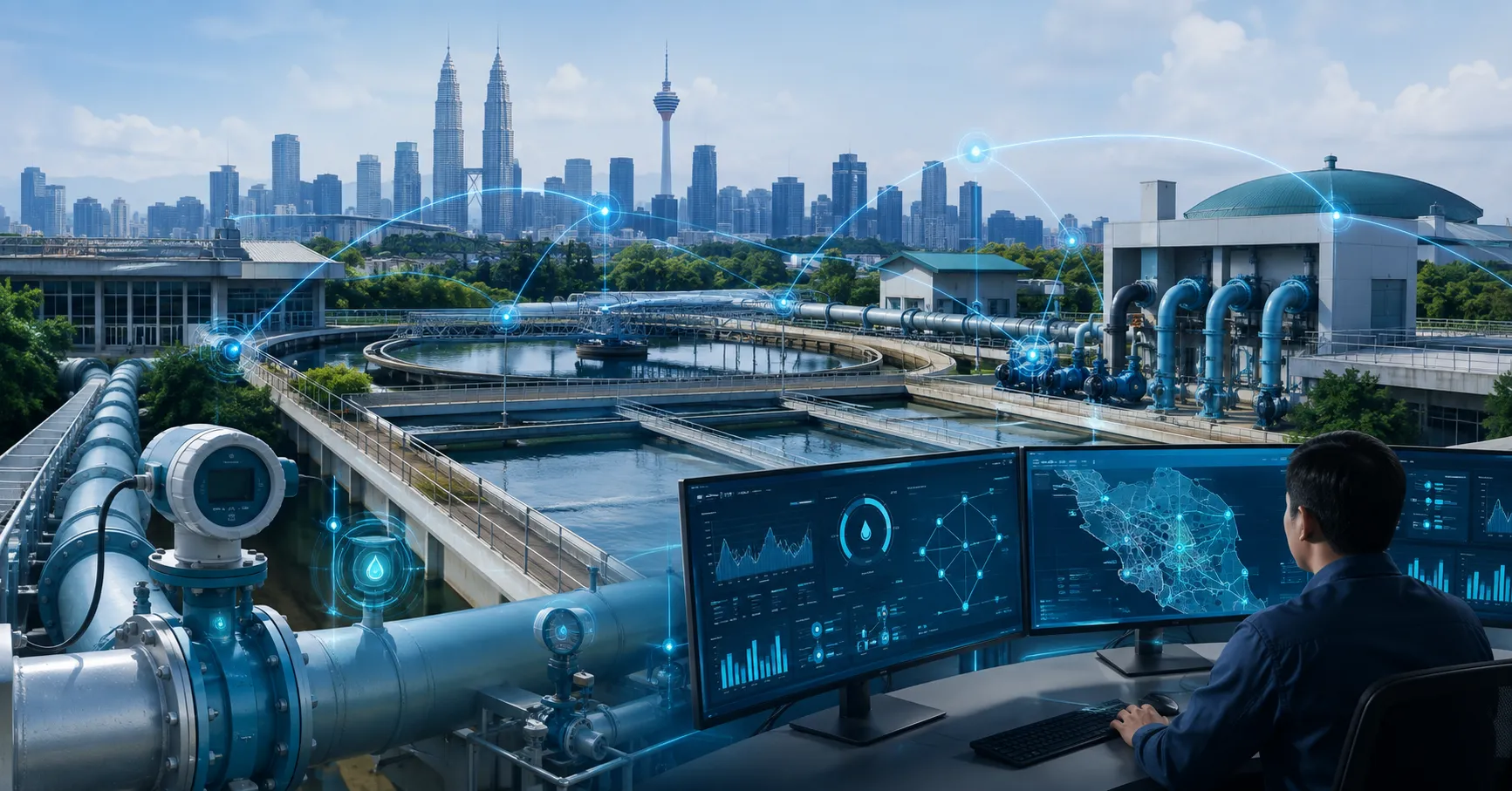
Strip away the buzzwords and every successful NRW programme rests on the same operational layer: accurate measurement, reliable communication from dispersed assets, and a control system that brings everything together.
- Continuous, self-diagnosing flow measurement: Magnetic flowmeters designed for water and wastewater applications can provide ongoing diagnostics and self-monitoring, helping operators identify issues such as electrode coating, corrosion, or changes in flow profile before they affect measurement accuracy or make leaks harder to detect.
- Telemetry for remote and dispersed assets: District metering zones, remote pump stations, and reservoirs are often spread across wide and difficult-to-access areas. Low-power cellular data loggers and wireless instrumentation networks can help utilities monitor these locations without the need to install extensive new cabling at every site.
- RTUs that go beyond basic data reporting: Smart Remote Terminal Units can combine remote monitoring, local control, and autonomous data logging, making them particularly suitable for unmanned or remote sites that require both central supervision and the ability to respond locally.
- A SCADA/HMI layer that brings it all together: Instrumentation, telemetry, and RTUs deliver the greatest value when operators can view and manage the information through a centralised platform. This helps utilities identify anomalies, manage alarms, monitor network performance, and turn district metering zone data into actionable operational insights.
For water and wastewater operators, the opportunity is not simply to deploy individual technologies, but to build a more connected and visible operating environment. Foxboro is looking to support the water segment through its instrumentation, RTU, telemetry, and SCADA capabilities, working together with the wider Schneider Electric ecosystem and qualified system integrators.
This combination of field instrumentation, remote connectivity, local control, and centralised supervision can help utilities strengthen operational visibility and create a more informed foundation for NRW reduction, network optimisation, and future digitalisation initiatives.
Why This Matters Beyond the Engineering
For utility operators, the business case is direct: every percentage point of NRW reduced is treated water that doesn’t need to be re-treated, re-pumped, and re-billed. Where capex grants are tied to NRW KPIs, better instrumentation isn’t just an efficiency play — it directly affects what gets reimbursed. And for plants exposed to upstream pollution risk, better network visibility means catching contamination and pressure anomalies early enough to avoid a full shutdown-and-ration cycle.
How Foxboro Supports Water & Wastewater Digitalisation in Malaysia
Want to assess where instrumentation gaps may be contributing to NRW losses at your facility? Get in touch with Foxboro’s engineering team to discuss your water and wastewater automation needs.
Frequently Asked Questions
NRW is treated water that’s produced but never billed — lost through leaks, unmetered use, faulty meters, or theft. In Malaysia it currently runs at an estimated 25–40% depending on the state, representing a major loss of treatment investment, energy, and revenue for water operators.
Estimates put NRW losses at 25–40% across most states. Under the Water Sector Transformation 2040 roadmap, the government is targeting both a reduction in NRW and a sector contribution of 0.45% to GDP by 2040, backed by an estimated RM172.6 billion in accumulated value-add through 2040.
It’s a virtual model of a physical plant, fed by live operational data, that allows the system to simulate, predict, and in advanced cases autonomously manage operations like startup, standard running, and shutdown sequences. Air Selangor’s Semenyih 2 WTP, built with Schneider Electric, is Malaysia’s first example of this in production.
Modern magnetic flowmeters run continuous self-diagnostics, detecting issues like electrode corrosion or coating and changes in flow profile that could otherwise distort billing data or mask leaks — catching problems long before they show up as a revenue shortfall.
Yes. Low-power cellular telemetry and wireless instrumentation networks are specifically designed for dispersed assets like pump stations and reservoirs, transmitting data securely without requiring new cabling to every site.
Operators that meet government-set NRW reduction KPIs can receive capital expenditure grants — in some cases covering up to 75% of qualifying project costs — making instrumentation upgrades directly tied to financial return, not just operational efficiency.